



AI Workflow, Small Business Automation, SimplySync AI
How to Build Your First AI Workflow: A Beginner’s Guide for Small Businesses
The hardest part of AI automation is usually not the technology. It is knowing where to start. Many business owners try to automate too much at once, pick a workflow that is too complex, or delay automation because they assume they need deep technical experience. The better path is simpler: choose one clear, repeatable process, automate it well, prove it works, and then build from there. This guide walks you through that first AI workflow step by step, using real examples from service and appointment-based businesses, and shows where SimplySync AI can be your expert partner along the way.
What Is an AI Workflow?
📌 Short Answer: An AI workflow is a connected series of steps that uses automation and AI to complete a business process. It usually starts with a trigger, performs one or more actions, makes simple decisions based on conditions, and alerts a human when needed.
In practical terms, an AI workflow is a series of automated steps that use AI and business rules to complete a task, such as responding to a lead, asking qualifying questions, booking an appointment, updating a CRM, sending reminders, or routing a conversation to a human. Instead of you or your team manually handling every step, the workflow runs in the background and only pulls you in when your judgment is needed.
A simple AI workflow example looks like this: Missed call comes in → system sends a text → AI asks what the customer needs → lead is qualified → CRM is updated → team gets notified → follow-up sequence begins. That entire flow can run without anyone having to pick up the phone the moment the call is missed.
Why Your First AI Workflow Should Be Small
When business owners first hear about AI workflow automation, they often jump straight to “automate everything.” That sounds exciting, but it is also the fastest way to get stuck, overwhelmed, or disappointed. Your goal for the first project is not to rebuild your entire operation. Your goal is to create one workflow that is useful, measurable, and easy to improve.
Faster launch: A small workflow can often be designed, built, and launched in days, not months.
Lower complexity: Fewer moving parts mean fewer ways for things to break or confuse your team.
Easier testing: You can test every scenario—normal, urgent, no response—without needing a full IT department.
Better team adoption: Staff can understand what the workflow does and trust it, instead of feeling replaced or confused.
Clearer ROI: It becomes obvious if you are booking more appointments, saving hours each week, or recovering missed leads.
More confidence: Once you see one workflow working, the next one feels much less intimidating.
SimplySync AI specializes in helping small businesses pick that first, practical workflow—whether it is missed-call text back, automated lead response, appointment booking automation, or quote follow-up—so you start with a quick win instead of a giant project.
How to Choose Your First AI Workflow
Factor 1: Frequency
Start with something that happens often. The more frequently a process runs, the faster you see value from business workflow automation. Common high-frequency candidates in service and appointment-based businesses include:
Missed calls during busy hours or after hours
New website forms or chat inquiries from potential clients
Appointment confirmations and reminders for clinics, med spas, or consultants
Quote and estimate follow-ups for contractors and home services
Review requests after completed jobs or visits
Factor 2: Simplicity
Your first AI automation for beginners should have clear steps and simple decisions. A helpful rule of thumb: if you can explain the process in 3 to 7 steps, it is likely a good first workflow. For example, “missed call → text → ask what they need → mark urgent or not → notify team” is simple enough to start with.
Factor 3: Impact
Finally, pick something that touches revenue, customer experience, or major time savings. Good first workflows often improve:
Revenue: capturing more leads, booking more appointments, or closing more quotes.
Customer experience: faster responses, clearer next steps, fewer no-shows.
Time savings: reducing manual follow-up, data entry, or repetitive reminders.
Formula: High frequency + simple steps + meaningful impact = strong first AI workflow.
SimplySync AI uses this framework with clients to identify the best starting point—often a missed-call text back workflow, automated lead response workflow, appointment booking automation, or quote follow-up workflow that can show results quickly.
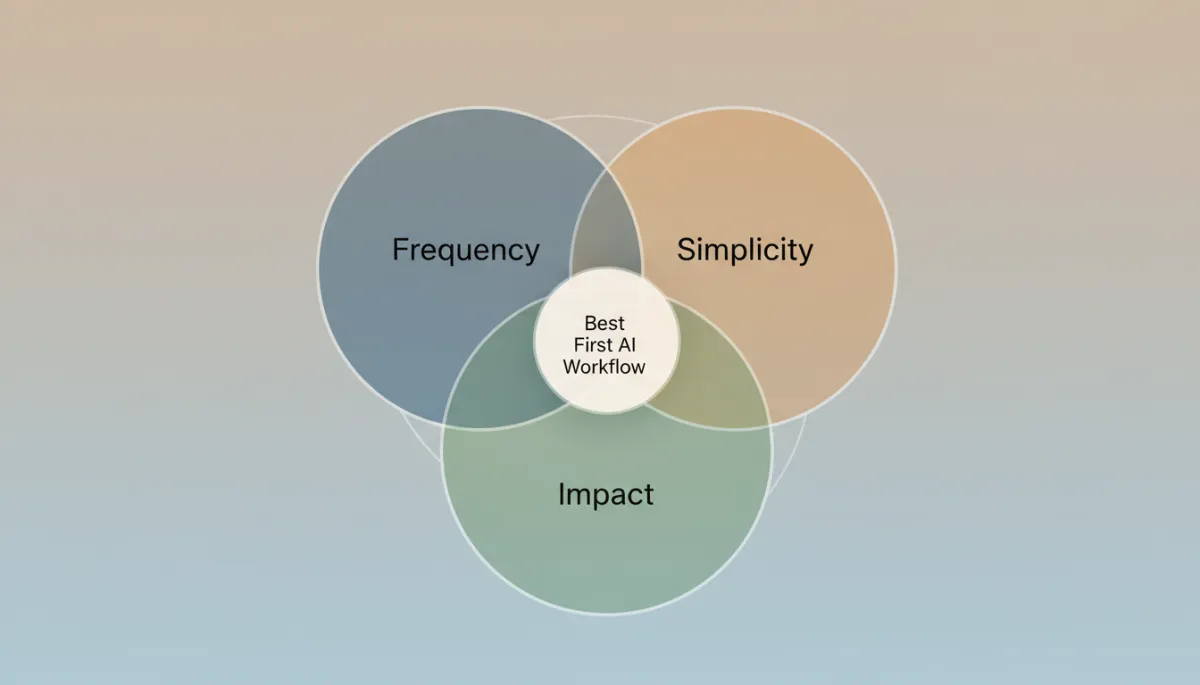
The best first AI workflow sits where frequency, simplicity, and impact overlap.
Best First AI Workflows for Small Businesses
Workflow 1: Missed-Call Text Back Workflow
Trigger: A call is missed during business hours or after hours.
Send an instant text acknowledging the missed call and asking how you can help.
Use AI to ask a few short questions to understand the need and urgency.
Detect urgent issues (for example, “no heat,” “water leak,” “emergency”).
Notify the right team member or on-call technician for urgent cases.
Create or update a CRM record with the caller’s details and conversation.
Why it works: This missed call text back workflow recovers leads that would otherwise go to voicemail and then to a competitor. It is one of the highest-ROI AI workflow examples for local service businesses.
Workflow 2: New Lead Response Workflow
Trigger: A website form, chat message, or email inquiry comes in.
AI sends a friendly, branded response within seconds, confirming receipt.
AI asks 2–4 qualifying questions (location, timeline, budget range, service type).
CRM is updated automatically with the answers and lead status.
A booking link is sent or a call-back time is confirmed if appropriate.
A simple AI lead follow-up workflow continues if the lead does not book.
Why it works: This automated lead response workflow improves speed-to-lead, which is critical in competitive markets like real estate, med spas, and home services. Faster response usually means more booked appointments.
Workflow 3: Appointment Reminder Workflow
Trigger: An appointment is booked in your calendar or scheduling tool.
Send instant confirmation with date, time, location, and preparation steps if needed.
Send a reminder 24 hours before the appointment with reschedule options.
Send a final reminder 2 hours before the appointment.
If the customer no-shows, trigger a follow-up asking to rebook.
Why it works: This appointment booking automation reduces no-shows and saves admin time in clinics, med spas, and consulting practices. It is a classic business workflow automation win.
Workflow 4: Quote Follow-Up Workflow
Trigger: A quote or estimate is sent from your CRM or quoting tool.
Day 1: Send a friendly check-in asking if they have any questions.
Day 3: Send a brief value reminder about what is included and why it matters.
Day 5: Send a quick SMS asking if they are still considering the project.
If no response, create a task for a personal follow-up call.
Why it works: This automated follow-up workflow prevents warm leads from quietly going cold, especially in higher-ticket services like remodeling, roofing, or consulting packages.
Workflow 5: Review Request Workflow
Trigger: A job is marked complete or an appointment is finished.
Send a thank-you message shortly after the visit or service.
After a short delay, send a simple review request with a direct link.
If feedback is negative, route it internally instead of posting publicly.
If feedback is positive, follow up with a thank-you and maybe a referral offer.
Why it works: This workflow automation for small business strengthens your online reputation and builds trust with future customers.
The 5-Phase Process to Build Your First AI Workflow
1. Document the Current Process
Before you touch any tools, write down what happens today, step by step. This is the most underrated part of business process automation. Answer questions like:
What starts the process? (missed call, form, quote sent, etc.)
Who handles it right now?
What steps happen next, and in what order?
Where do delays or dropped balls usually occur?
What information is needed to do this well (name, service type, date, etc.)?
What does success look like? (booked appointment, paid deposit, review left)
Example: For a plumbing company, the current process for missed calls might be: call comes in after hours → caller leaves voicemail (sometimes) → owner checks voicemail next morning → owner calls back → often the customer has already booked with someone else. This is exactly the kind of gap a simple AI workflow automation can close.
2. Design the Automated Version
Next, decide what the automated version should do and where humans should still be involved. Define:
The trigger (missed call, new form, appointment booked, etc.)
The first response (text, email, or chat message)
The questions AI should ask to qualify or route the lead
The conditions (for example, urgent vs routine, new vs existing customer)
The CRM workflow automation steps (create or update records, set statuses)
The notifications (who should be alerted, and when)
The follow-up sequence (how many messages, over how many days)
The human handoff rules (what should cause a person to step in)
Example: Missed call → instant SMS → AI asks what is needed → if urgent, alert on-call tech → if routine, send booking link → update CRM with details → start 2-day follow-up if no booking. This is a clean, beginner-friendly AI workflow.
3. Build and Test the Workflow
Now you translate your design into a real workflow using an automation platform or by working with a partner like SimplySync AI. Even if you never touch the technical side, it helps to understand what is happening behind the scenes. A simplified pseudo-code version of a missed-call workflow might look like this:
# Pseudo-code for a missed-call text back AI workflow

def handle_missed_call(call):
    caller_number = call.from_number

    send_sms(
        to=caller_number,
        message="Hi, we just missed your call. How can we help you today?"
    )

    response = wait_for_reply(from_number=caller_number, timeout_minutes=15)

    if not response:
        tag_lead(caller_number, "no_response")
        notify_team("Missed call with no response from " + caller_number)
        return

    intent, urgency = analyze_message_with_ai(response.text)

    update_crm(
        phone=caller_number,
        last_message=response.text,
        intent=intent,
        urgency=urgency
    )

    if urgency == "high":
        notify_team("Urgent lead from " + caller_number + ": " + response.text)
    else:
        send_sms(
            to=caller_number,
            message="Thanks for the details. You can book a time here: https://yourbookinglink.com"
        )
        start_follow_up_sequence(caller_number)
When testing, make sure you:
Test normal cases (typical customer inquiry with clear answers).
Test urgent cases (emergencies, same-day needs).
Test no-response cases (customer never replies to the first message).
Test wrong or incomplete information (typos, vague answers).
Confirm CRM records are updated correctly every time.

